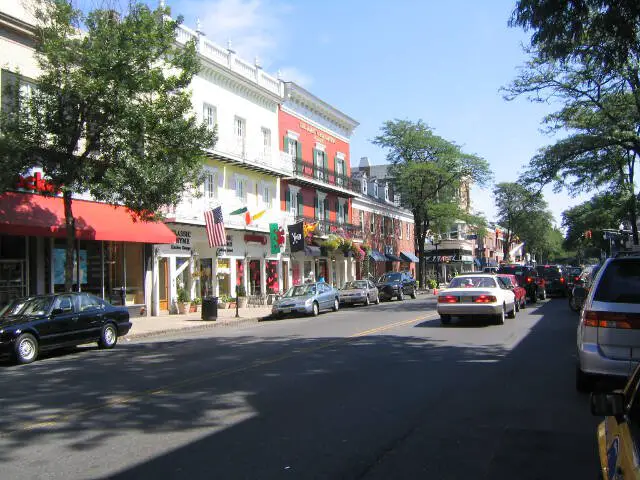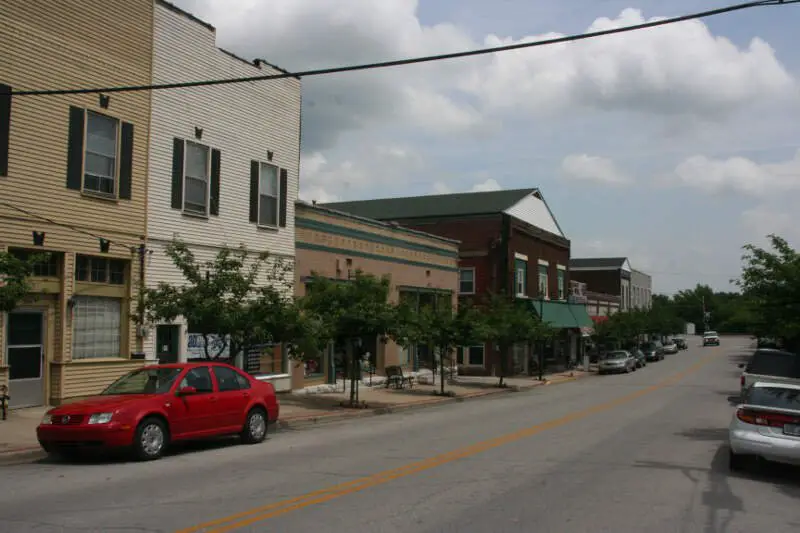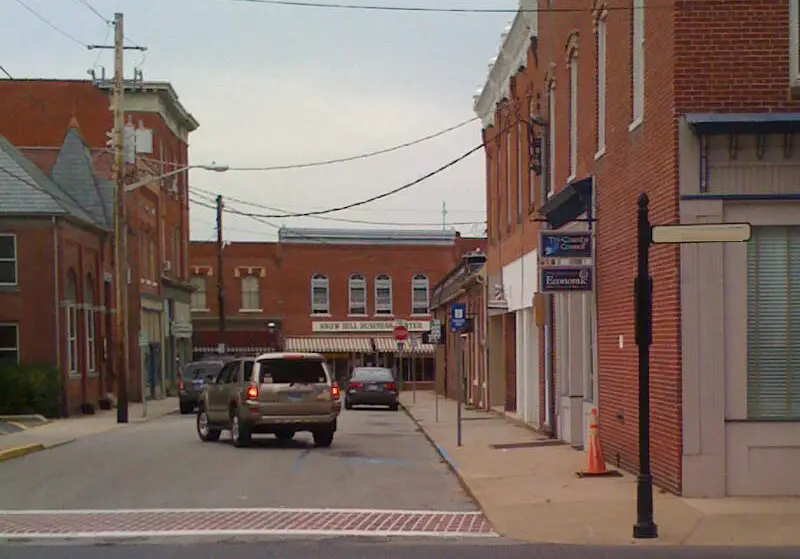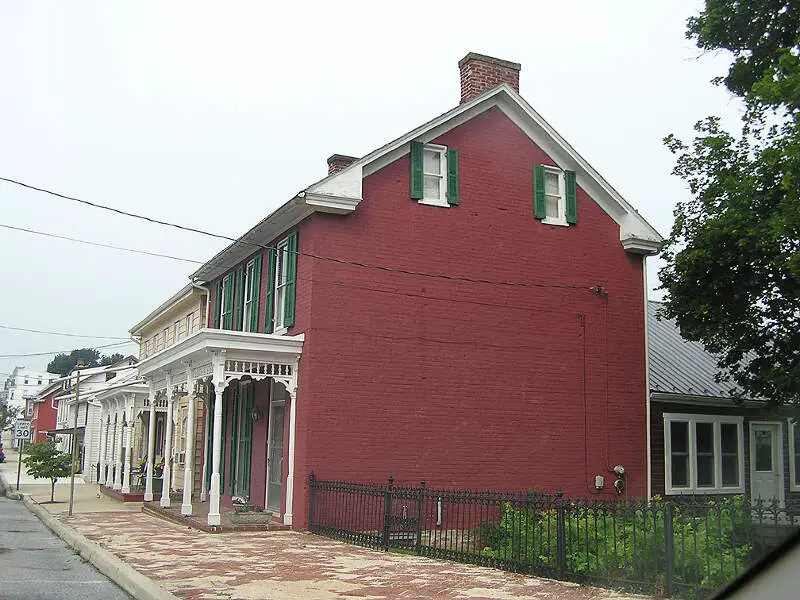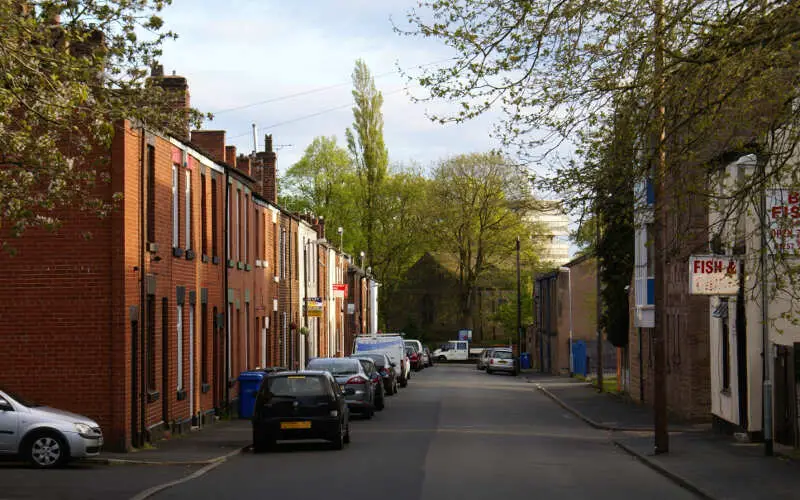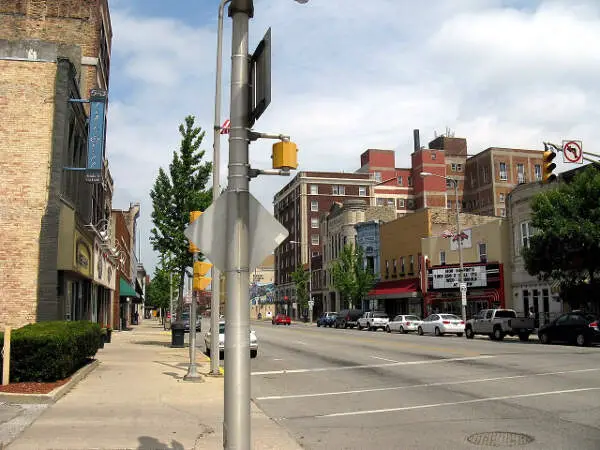
Kansas City vs. St. Louis in photos
A side-by-side look at each city.





Cost of living
St. Louis is the cheaper city overall — 10% higher in Kansas City than its rival. Index baseline: 100 = national average.
| Living expense | Kansas City | St. Louis | US average |
|---|---|---|---|
| Overall | 98 | 89 | 100 |
| Services | 99 | 98 | 100 |
| Groceries | 100 | 96 | 100 |
| Health | 95 | 82 | 100 |
| Housing | 95 | 97 | 100 |
| Transportation | 92 | 96 | 100 |
| Utilities | 95 | 95 | 100 |
Lower index = cheaper. 100 = U.S. national average. Bar inside each cell scales relative to the highest value in the table.
Sources: HomeSnacks Cost of Living indices, normalized so 100 = U.S. national average. Drill in: Kansas City cost of living, St. Louis cost of living, or the cheapest cities in America.
Housing breakdown
Home prices are higher in Kansas City. Compare absolute price and price-to-income — a $500k home in a $100k-income city is very different from one in a $50k-income city.
| Metric | Kansas City | St. Louis | United States |
|---|---|---|---|
| Median Home Value | $250,207 | $181,927 | $332,700 |
| Median Rent | $1,238 | $997 | $1,413 |
| Median Income | $69,166 | $56,160 | $80,734 |
| Home Value To Income | 3.6x | 3.2x | 4.1x |
| Rent To Monthly Income | 0.21x | 0.21x | 0.21x |
Source: U.S. Census Bureau ACS 2020-2024. See also states with the highest rent in America.
Crime
Kansas City is the safer city — total crime rate of 6,223 per 100k people vs 7,074 for St. Louis. US average: 2,119.
| Crime (per 100k) | Kansas City | St. Louis | US average |
|---|---|---|---|
| Total crime | 6,223 | 7,074 | 2,119 |
| Murder | 28 | 54 | 5 |
| Robbery | 254 | 250 | 61 |
| Aggravated Assault | 1,191 | 1,005 | 256 |
| Violent Crime | 1,547 | 1,367 | 359 |
| Burglary | 490 | 820 | 229 |
| Larceny | 2,454 | 3,412 | 1,272 |
| Car Theft | 1,731 | 1,475 | 259 |
| Property Crime | 4,676 | 5,707 | 1,760 |
Lower = safer. Bar inside each cell scales relative to the highest crime rate in the table.
Source: FBI Uniform Crime Reporting (2024). All rates are per 100,000 people. City pages: Kansas City crime, St. Louis crime. See also: safest cities in America.
Diversity
Kansas City is more racially diverse — lower HHI (closer to 0) means a more even mix across groups.
| Group | Kansas City | St. Louis | United States |
|---|---|---|---|
| White | 54.0% | 44.4% | 57.4% |
| African American | 25.2% | 42.1% | 11.9% |
| American Indian | 0.1% | 0.2% | 0.5% |
| Asian | 2.8% | 3.5% | 5.9% |
| Hawaiian | 0.2% | 0.0% | 0.2% |
| Other | 0.5% | 0.5% | 0.6% |
| Two Or More | 4.7% | 4.0% | 4.3% |
| Hispanic | 12.5% | 5.3% | 19.3% |
Source: U.S. Census ACS 2020-2024. Lower HHI = more even racial mix. See also: most diverse cities in America.
SnackAbility — overall quality of life
Kansas City scores higher overall — 5/10 vs 4/10. SnackAbility is our 1–10 quality-of-life score; the median U.S. city scores a 7.
Scores are 0–10; both bars share the same scale.
SnackAbility is a HomeSnacks proprietary 1–10 score blending jobs, housing, education, commute, amenities, affordability, crime, and diversity. Median U.S. city ≈ 7. Data: Census, BLS, FBI. See also: best places to live in America.
Getting around: Kansas City vs. St. Louis
How each city handles commuting, transit, walkability, and car culture — the day-to-day reality that shapes where you'd actually want to live.
Plan on owning a car in Kansas City. The city sprawls across a massive footprint, and the downtown streetcar covers just one corridor along Main Street through Midtown. Most residents drive for everything.
The highway grid is forgiving outside rush hour, and parking is rarely the ordeal it is in coastal cities. Kansas City's median rent of $1,238 reflects a market where living close to work carries less of a premium than in denser metros.
St. Louis has a real transit backbone in MetroLink, a light rail line connecting Lambert Airport through downtown and out to Clayton and Shrewsbury. Walkable neighborhoods like Soulard, the Central West End, and Lafayette Square mean you can go car-light if you choose your neighborhood carefully. Commuters crossing to Illinois also get free bridges.
Jobs and careers in Kansas City vs. St. Louis
The local job market, dominant industries, and which city to choose based on your career.
Kansas City's economy centers on finance, tech, logistics, and animal health. It hosts more animal health companies than anywhere else in the world. Major employers include Oracle Health (formerly Cerner), Hallmark, H&R Block, Children's Mercy, and HCA Midwest.
The median household income sits at $69,166, and the Crossroads and Startup Village areas have pulled in a steady stream of tech workers.
St. Louis leans on aerospace (Boeing), financial services (Edward Jones, Mastercard's large tech campus), and biotech around the Barnes-Jewish and Washington University medical corridor. Enterprise Holdings and Centene add Fortune 500 weight.
The median household income here is $56,160, roughly $13,000 below Kansas City's. St. Louis's cost of living index of 89 versus KC's 98 softens that gap in practice.
Weather and climate
What to expect day-to-day — sun, fog, heat, rain, and the seasonal extremes that shape the lifestyle.
Both cities are deep in the Midwest humidity belt. Expect hot, sticky summers and winters with real bite.
Kansas City averages about 18 inches of snow a year and sees more tornado activity given its proximity to the open Plains. If spring sirens are a dealbreaker, factor that in. Summer highs regularly hit the upper 80s and low 90s, with dew points that make it feel worse.
St. Louis runs slightly warmer overall, though you'd be hard pressed to call either city mild. Snowfall there tends to be lighter than Kansas City's.
Both cities get dramatic spring storm seasons. Neither offers year-round outdoor comfort like the Sun Belt, but if you want four actual seasons, both deliver.
Culture, nightlife, and entertainment
Food, music, neighborhoods, and the city vibe that gives each place its personality.
Kansas City's cultural identity runs on barbecue and jazz. Joe's KC, Q39, and Jack Stack anchor a BBQ scene taken seriously far beyond Missouri's borders. The 18th and Vine Historic Jazz District preserves the city's role in shaping American music.
The Power and Light District drives downtown nightlife, and the Crossroads Arts District has built a real gallery and restaurant scene that draws younger creative types. Chiefs and Royals fandom functions like civic infrastructure.
St. Louis has deep brewing roots, and the Anheuser-Busch brewery tour is a genuine institution. Soulard hosts one of the country's largest Mardi Gras celebrations outside New Orleans and stays lively year-round with live music bars.
The Hill is a tight-knit Italian neighborhood with old-school delis and trattorias. Cardinals baseball borders on religion. Washington Avenue and the Grove add nightlife variety, all at price points reflecting that cost of living index of 89.
Outdoor activities and day trips
Parks, beaches, hikes, and the weekend escapes that define life outside the city limits.
Kansas City's main outdoor anchor is Swope Park, one of the largest urban parks in the United States, home to Lakeside Nature Center and the Kansas City Zoo. Loose Park and Tiffany Greens offer green space closer to residential neighborhoods.
For longer trips, the Flint Hills, a rare stretch of tallgrass prairie, sit about 90 minutes west. The Lake of the Ozarks is an easy two-hour drive for boating and fishing. The city's trail network along the Blue River corridor is popular with cyclists and trail runners.
St. Louis's biggest draw is Forest Park, a 1,300-acre urban park larger than Central Park. It houses the St. Louis Zoo, the Saint Louis Art Museum, the Missouri History Museum, and the Science Center, all free to enter.
Castlewood State Park and the Meramec River are close for hiking and swimming, and the Ozark Trail's northern terminus is reachable within an hour. Both cities have solid outdoor access, but Forest Park alone makes St. Louis hard to beat for in-city green space.
Bottom line: which city is right for you?
Based on the head-to-head data above, here's the short version — pick the city that lines up with what you actually care about.
Choose Kansas City if you prioritize…
- lower crime — a safer place to live, work, and raise a family.
- more affordable housing relative to St. Louis.
- a more racially diverse community (lower HHI on Census data).
- a higher overall SnackAbility quality-of-life score.
Choose St. Louis if you prioritize…
- a lower cost of living (cheaper groceries, services, and day-to-day expenses).
Methodology: winners are picked from public data — U.S. Census Bureau ACS (income, home value, rent, race/HHI), FBI Uniform Crime Reporting (crime rates per 100k), and HomeSnacks' proprietary SnackAbility quality-of-life score, which blends Bureau of Labor Statistics data with the above.
Other comparisons
Still weighing your options? See how these two cities stack up against other places we've compared head-to-head.